Using Resources Responsibly
Responsible planning and building is becoming increasingly important.
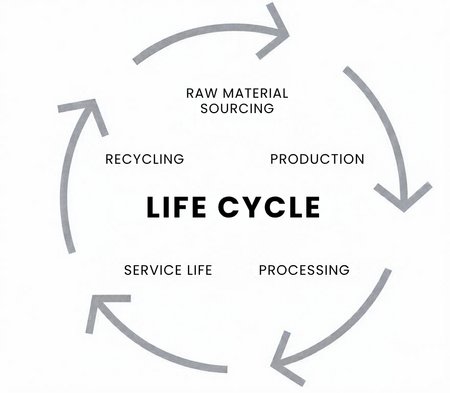
The efficient use of resources plays an important role in the long-term management of materials and building projects. This includes reducing resource consumption, supporting material cycles, and considering durability as part of planning and construction processes.
For more than 50 years, RHEINZINK has continuously developed its titanium zinc material. Properties such as durability, recyclability, and a long service life contribute to the use of titanium zinc in a wide range of construction applications. These characteristics support future-ready architecture and long-lasting building solutions.
Characteristic Appearance Over Time.
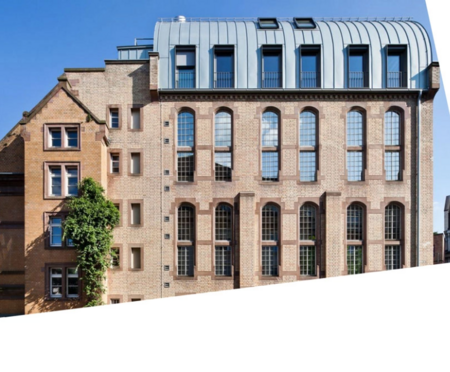
If a building clad in RHEINZINK could tell its story, it would reflect many decades of use. RHEINZINK products are used for roofing, façades and drainage applications and are characterized by a long service life.
At the end of a building's use phase, or during renovation and refurbishment projects, titanium zinc components can be separated from other materials and returned to established recycling streams. This allows the material to be processed and used again in future applications.
Aesthetic Appeal That Returns.
Titanium zinc can be returned to established material cycles after its use phase and processed for future applications. RHEINZINK products are not consumed in the traditional sense. Instead, the material can continue to be used in new forms, on new buildings, and in new applications.
RHEINZINK products are used in a wide range of construction projects and are characterized by a long service life. After renovation, refurbishment or dismantling, titanium zinc components can be separated from other materials and directed to recycling streams. This allows the material to remain part of material cycles and be used again in future applications.
prePATINA ECO ZINC in figures
Aesthetics with responsibility.
RHEINZINK has the material for great ideas and architects such as Daniel Libeskind, Zaha Hadid, Nicholas Grimshaw – and at the same time has a small footprint. Titanium zinc generally has a very small CO2 footprint. For more details on the footprint, see EPDs.
RHEINZINK & carbon reduction

Less CO² - more responsibility.
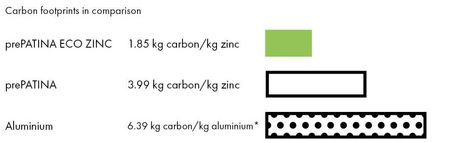
prePATINA becomes prePATINA ECO ZINC with 50% less CO2 - compared to the previous product line
with prePATINA ECO ZINC, we are taking a big step forward in the reduction of CO2 in the construction industry. Compared to other construction metals, RHEINZINK has long required very little manufacturing energy. With prePATINA ECO ZINC from one of our numerous product lines, we are taking the next step in our sustainability strategy towards decarbonised production. It is the first product in which we use only raw materials that were produced with genuine renewable energies. The raw material is produced in Scandinavia using renewable energies and is added to our prePATINA ECO ZINC product line as part of the mass balancing process.
Copilot said: Longevity and RHEINZINK – A Special Connection
You are on our global website.
Would you like to stay on rheinzink.com or visit the local RHEINZINK America website?